





The minibus was once advertised as a Luxury Video A/C Coach. Time has stripped it of adjectives. It is now merely a battered bus with On Time Travels blazoned on one side. The other side has a logo. Our travellers take great pride in this logo. It is frequently pointed out to lower forms of Nalandan life as an example of what intelligent compromise can achieve.
Not so very long ago, On Time Travels was the subject of acrimonious dispute. There was a rumour that the name had been misspelt. It was really Om Time Travels. The bus was due for a facelift, and some of the commuters wanted the name spelt right this time. Others disagreed. They said it quarrelled with the secular spirit of the times. The driver, Makhanlal, generally addressed as Maska, refused to referee. The owners, he said, were illiterate. The bus had been leased to Nalanda, and Nalandans must decide.
For a whole month, the warring factions glared across the aisle. Finally, Nitin Pai, artist-in-residence, broke the deadlock with a logo. This was the Om symbol with the crescent replaced by a tiny clock. Everybody felt this was neat. Nitin was congratulated. He passed on the laurels to Mr Thomas, whose idea it really was.
Mr Thomas, in turn, deferred to God. He reminded them that His blessings made all things possible, even in Nalanda.
Compared to its sides, the bus has a remarkably reticent rear. Not even a sticker defaces it. The insides are quite another matter. Like the caves of Maharashtra, the cream rexine interior has lent itself to free expression. From the lewd to the sublime, here are the navarasa rendered in ballpoint, fibre tip, pencil, penknife and perhaps, even in blood. Passion – romantic, patriotic, religious – is everywhere, in fervid squiggles that have etched the rexine. Less compelling are avarice, hope and despair which appear as shopping lists, tax calculations and household accounts. Strange inky arthropods roam in pairs, linked by the verb loves.
In more secluded locations are drawings of the most optimistic eroticism.
Last month, Mr Thomas summoned a meeting about these. He pointed out that as parents they should be concerned — the bus had recently carried schoolboys.
Mothers protested loudly, defending the purity of their offspring. Arun Malik said it was a non-issue. They had all been schoolboys once, and for all he knew, schoolgirls were even worse. The men backed him up, but the women looked insulted.
Gauri Kamath remarked that Arun Malik was not qualified to speak.
Arun retorted that his daughter was nearly 16, whereas Gauri was still, visibly, several months away from motherhood.
Gauri crushed him by agreeing sweetly, “We are talking about normal children here, aren’t we?”
At that, everybody hastily began cleaning the walls with materials at hand – soap, petrol, nail-polish remover.
This lent the drawings an impressionistic haze, rendering them a good deal more interesting. Now the bored commuter can spend an instructive half an hour decoding the blurs. It beats the crossword any day. On really dull mornings, it can be spun out all the way till Nariman Point.
This morning, Gauri Kamath and Farheen Sheikh have no time for such idylls. Gauri is intent on the couple in front of them. All she can see is the back of their heads, suspiciously close. Sensing her needly gaze, they spring apart guiltily, and Gauri nudges Farheen with a grim look of vindication.
Farheen is far away, in a dream where her children gobble their magic breakfasts, find socks, pencils, homework and a science project ten minutes before the school bus arrives. She thinks with sorrow of last month’s Nature Study discovered this morning beneath Salim’s bed in her quest for Noor’s missing sock. They had forgotten that pupae must eventually burst. The shoebox, the holes on its lid clogged with dust, was full of dead butterflies.
Farheen had managed to hide it from the children just in time.
Noor would have lost her breakfast and forgotten about it. But Salim would have gone silent and white and clenched his fists, hammered them against his sides as he stared and stared. Why couldn’t he just cry?
She hadn’t found the sock either. Noor flatly refused to wear navy socks on a PT Day.
“Either that, or go barefoot!” Farheen, one eye on the clock, issued her ultimatum.
“Wear one of mine,” Salim offered reasonably. “Then we can both wear one blue and one white.”
Finally, Noor went without socks.
“No socks is better than wrong socks,” she said. “I’ll say they didn’t dry.”
“Don’t lie, Noor,” Farheen said weakly.
Both children turned on her indignantly.
“That’s not a lie, Ma!”
Salim, as usual, was willing to explain.
“It is like when you told the office we had chicken pox and we had gone to Bangalore. Remember?”
Farheen watched them race to the gate just in time for the school bus. Rahim’s mother waved to them from the third-floor window of 27-D. The old woman wouldn’t have missed a thing.
By evening, all Nalanda will know that poor Shakila Aunty’s daughter-in-law sends her children to school barefoot.
The children still race barefoot through Farheen’s mind when Gauri whispers hotly in her ear.
“Didn’t I tell you?”
Gauri has Farheen’s attention at last.
Farheen tosses back her mane of brown hair and sends a gust of Joy billowing across the bus. She frowns in concentration at the heads in front, and agrees.
Farheen is a tall woman. The scalloped hem of her ambitiously cut black dress is gathered around her calves like a calyx. Her legs are Farheen’s principal comfort. They are long, white, solid, and end today in black suede pumps with six-inch heels. Even without the shoes, her legs set Farheen apart from the dowdy company of shins squamose or hispid that lurk within saris and shalwars.
The heads under scrutiny belong to Maya Joshi and Arun Malik.
“I’m sure, absolutely sure,” Gauri mutters. “Those two are having a roaring affair.”
Farheen marshals the evidence and agrees. They are having a roaring affair.
Are they?
This morning Maya and Arun are in the angry throes of a quarrel. They belong to a generation that is powerless to be anything but polite in public. They are both reading. Arun, the newspaper; Maya, Time magazine. Between them the paper rattles in a muted convulsion of rage.
“What’s wrong with you today?” Arun asks at last.
Wrong with her! After all that happened yesterday, he asks what’s wrong with her!
It baffles the rising tide of words in Maya. No longer does she yearn for a Rampuri knife to sink into his ribs. Rage is like dry ice in her lungs. Its clean cold breath tinkles her words like ice cubes. With well-bred ease she says, “I’ve a cold coming on.”
“Oh.”
Maya decides he sounds disappointed. She has stolen his lines.
“Jinny has a cold,” he says.
“Is she running a fever too? Children –” Savagely, he bites at her sentence. “ – of her sort have poor immunity? Isn’t that what you want to say? Why don’t you spell it out? Why don’t you say Downies have poor immunity? That’s what she’s called in Nalanda, isn’t it? That Downie girl.”
His barbed words draw blood.
As always, by some subtle shift of ground, Maya has become the aggressor. From now, it will only grow worse. There is nothing she can say.
“16 years!” Arun addresses the passing scenery, “I should be used to it by now!”
Maya slips a hand into the crook of Arun’s arm and feels his muscles clamp greedily on it. She feels the thud of his chest against her hand and thinks, how can I belong in there? What will I do in that strange space? She feels no such strangeness with Jinny. It is so much easier to love a child. Jinny has a sureness in her pulse, a focus in her gaze. Arun scatters her. Sadly, Maya ponders the changing pace of love, its darker, insoluble, uncertainties.
The bus slows and Gauri’s voice is suddenly audible.
“She must be 40, don’t you think?”
“Sssh!” Farheen refuses to think.
Maya smiles. They are discussing her. Gauri is off the mark by three years. Maya is 43. She snuggles closer to Arun.
Their quarrel will keep. It is enough now that she is here with him, watching the grey slums of Azad Nagar gild themselves in a sudden haze of happiness.
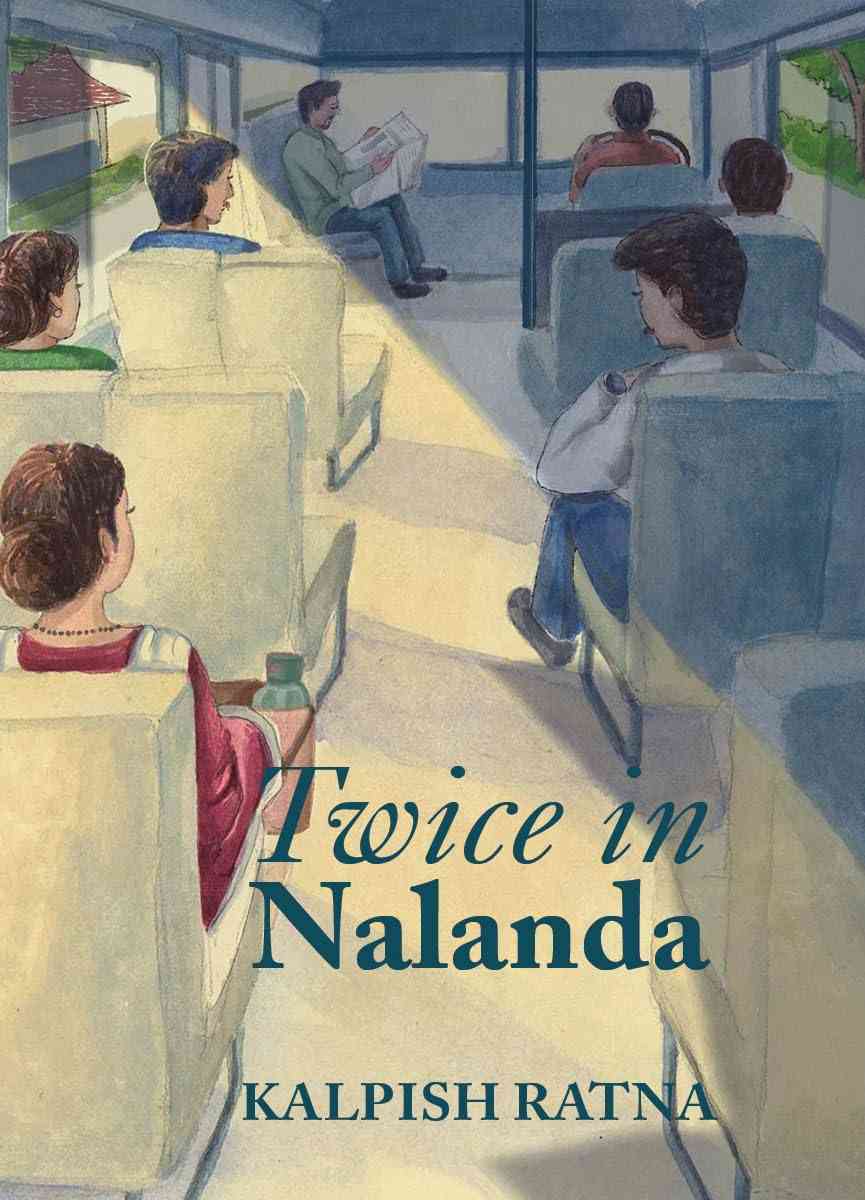
Excerpted with permission from Twice in Nalanda, Kalpish Ratna, Red River Press.
